

Crime
The House That Lies Built: Unmasking The Tali Shani Fraud


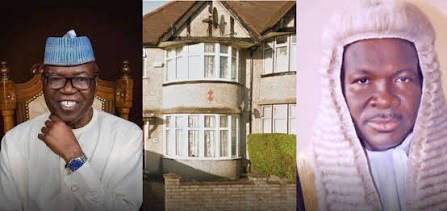
In the annals of Nigerian political intrigue and legal drama, few cases have proven as bizarre and layered as the “Tali Shani” affair. What began as a dispute over a London property has since unfolded into an astonishing web of forged identities, shifting loyalties, and grave ethical questions—touching the late General Jeremiah Useni, one of Nigeria’s longest-serving military officers, and Chief Mike Ozekhome, SAN, one of the country’s most prominent lawyers.
At the heart of the matter is a property in Randall Avenue, London, purchased in November 1993. According to the UK Court, the house was secretly acquired by then-Minister of the Federal Capital Territory, General Useni, with funds that were ostensibly looted. To conceal ownership, he registered the property under a fabricated alias, “Tali Shani”—a name the Tribunal later found bore similarities to one of his known pseudonyms, “Tim Shani.”
For years, the property generated rental income under General Useni’s control, managed by his appointed agents. But decades later, an extraordinary contest erupted over who truly owned the house.
Ozekhome’s Bid
In 2019, Chief Mike Ozekhome claimed to have encountered “Mr. Tali Shani,” who, according to him, was the original purchaser and registered owner of the property. Ozekhome, already known to be General Useni’s legal counsel, suddenly emerged as lawyer to this supposed Mr. Shani as well. In a series of legal maneuvers, Ozekhome obtained powers of attorney from “Mr. Shani,” and by 2021 executed a transfer purporting to vest ownership in himself—without paying a penny. He later told the Tribunal, under oath, that the house had been donated to him in gratitude for “legal services” rendered.
The Phantom Girlfriend
Before the ink was dry, another claimant appeared. This time it was “Ms. Tali Shani,” who alleged she had been General Useni’s girlfriend in the early 1990s. According to her, the General bought the property for her, and Ozekhome was now trying to steal what was rightfully hers.
Yet the mystery deepened. Ms. Shani never attended court. Instead, her Nigerian lawyers filed documents and produced witnesses to prove her existence. But under judicial scrutiny, the paperwork crumbled. Forged documents were exposed. Her supposed relatives gave contradictory accounts. When the Tribunal insisted she testify by video link, news suddenly broke that she had died in October 2024. The judge later concluded she had never existed at all.
What Useni Said Before His Death
In a twist, Ozekhome called the aging General Useni to testify. Appearing frail but lucid, the retired officer cut through the fog with startling clarity:
“I owned it. I bought the property. It is my property.”
He categorically denied knowing any “Mr. Tali Shani” or “Ms. Tali Shani.” He also denied ever authorising Ozekhome—or anyone else—to transfer his property.
It would be the last major public testimony of his life. On 23 January 2025, just months after his appearance before the Tribunal, General Useni died in France at the age of 81. His death left the case without its most credible witness, but his words had already shaped the outcome.
The Tribunal’s Findings
By September 2025, the UK Tribunal delivered a judgment that read like a crime thriller. Its key findings:
- The true purchaser of the Randall Avenue property was General Jeremiah Useni.
- “Ms. Tali Shani” never existed; she was a fabrication, supported by forged Nigerian documents.
- “Mr. Tali Shani” was not the original buyer and had no credible explanation for the source of funds.
- Chief Mike Ozekhome, while acting as lawyer to both Useni and “Mr. Shani,” attempted to register the property in his own name without authority.
In a scathing observation, the Tribunal noted that everyone in the saga—save General Useni—had engaged in deception.
Ethical Shadows
The judgment raises unsettling questions. Could one of Nigeria’s most celebrated Senior Advocates have crossed ethical lines by exploiting his lawyer-client relationship with a military patron? Did the legal profession turn a blind eye while forged identities were paraded in a UK court? For Nigeria, already battling international reputational crises, the “Tali Shani” case casts a long shadow.
What is clear is that the Tribunal’s decision has stripped the veil from a decades-old secret: the property was bought with ill-gotten wealth, hidden behind a false name, and later fought over by friends, lawyers, and phantoms.
The story of “Tali Shani” is more than a property dispute. It is a parable about power, greed, and the dangerous intersections of law and politics in Nigeria.




-

 Society News5 years ago
Jamaican man beheads wife after finding out their 6 kids are not his
-
 Society News7 years ago
EXCLUSIVE: The Complete Story of Dolapo Awosika, John Fashanu and Prophet Kasali Sex Mess
-

 News6 years ago
Pastor Osagie Ize-Iyamu, His Membership Of Secret Cult, And Other Issues Touching On His Public Credentials Examined by Barr. PATRICK I. BIOSE
-

 News6 years ago
BREAKING: Ajimobi’s daughter-in-law blast Gov. Makinde, says gov can’t surpass ex-Oyo gov
-

 Society News6 years ago
The Rise and Fall of “Jumoke The Bread Seller”
-

 News6 years ago
BREAKING: 2 arrested as NAF begins investigations into Tolulope’s death
-

 Crime6 years ago
Exclusive: Female Aide Fingered In Oko Oloyun’s Murder + Banking Transactions That Nailed Husband
-

 News6 years ago
BREAKING: Police take over Edo House of Assembly as APC, Oshiomhole move to seize control


You must be logged in to post a comment Login