

Featured
The Gospel of Two Leaders: One Preaches Hope, One Dredges Despair


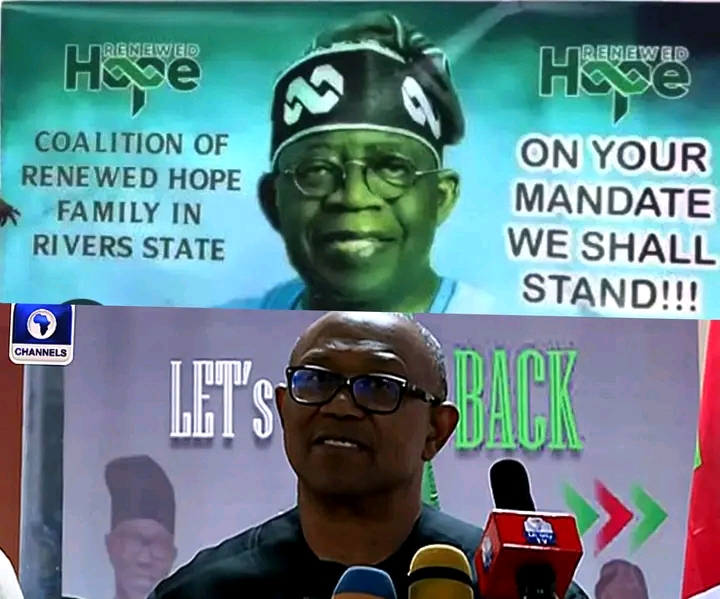
By Olabode Opeseitan
Prelude: Nigeria at the Crossroads of Emotion and Imagination
In the build-up to the 2023 election cycle, two voices rose above the din—each carrying a gospel. Bola Ahmed Tinubu and Peter Obi, though united by ambition, diverged in tone, texture, and trajectory. Their messages—one luminous, one lamenting—have shaped not just political discourse, but the emotional climate of a nation in search of meaning.
This is not a partisan lament; it is a kaleidoscopic meditation on leadership messaging—how it stirs or stifles hope, how it builds or breaks the scaffolding of national belief.
I. Tinubu’s Gospel of Hope: From Campaign to Reform
From the outset, Tinubu’s message was one of renewed hope. He acknowledged Nigeria’s wounds, but refused to let them define its destiny. His campaign was a call to redemption through resilience—insisting that Nigeria’s best years were ahead, not behind.
Campaign Messages That Resonated
- “Hope is not a slogan. It is a call to action. Nigeria will not remain in darkness; we will light the path forward.”
- “We are not defined by our past failures; we are propelled by our future possibilities.”
These messages, delivered across the country, struck a chord with a hurting nation. The majority gave him the mandate to lead.
Post-Election Reforms as Bridges of Hope
Since assuming office, Tinubu has introduced reforms that—while painful—signal a long-term vision:
- Fuel Subsidy Removal: freed up ?9 trillion for infrastructure and social investment.
- Exchange Rate Unification: cleared over $7 billion in forex backlogs.
- Student Loan Scheme: about 400,000 students have received interest-free loans.
- Compressed Natural Gas Initiative: saving ?2 trillion monthly in transport costs.
- Infrastructure Drive: Lagos–Calabar Coastal Highway, Trans-Saharan Superhighway, and rail revitalization.
- Healthcare Expansion: doubling primary health centres and building cancer diagnostic hubs.
Economic Indicators Turning
- Inflation has dropped from over 33.2% to 21.88% as of July 2025.
- Forex reserves surged to $41 billion—the highest since December 2021.
- Oil production rose from 1mbpd to 1.83mbpd, with targets set at 2.5mbpd.
- Electricity generation peaked at 5,801MW, with distribution capacity rising to 5,639MW.
- Stock Exchange: NSE All-Share Index up 45.79% year-on-year, making it one of the world’s best-performing markets.
- Security: multiple terrorist leaders captured or neutralized, including Ansaru commanders behind the Kuje jailbreak.
These are not abstract metrics; they are flickers of hope breaking through the fog of despair.
II. Obi’s Gospel of Reckoning: Between Hope and Despair
Peter Obi’s campaign was a clarion call for moral reset. He spoke of frugality, accountability, and a new Nigeria led by the youth. His message resonated with millions disillusioned by establishment politics.
Messages of Hope
- “A new, more prosperous, more united Nigeria is not only possible, but within reach.”
- “Despite setbacks, our resolve and optimism remain unshaken.”
- “Despair is not an option. Surrender is not a choice.”
Messages Dredging Despair
- “We are now one people under hunger.”
- “The population of the multi-dimensionally poor has climbed to over 80%.”
- “Our national economy is in its worst state ever.”
- “Leadership has become a criminal racket.”
These statements, while emotionally charged, often ignore the empirical improvements across key sectors. When despair becomes habitual, it risks making logic comatose.
III. The Anatomy of Hope and Despair: Four Dimensions
Leadership messaging is not just rhetoric—it shapes the emotional architecture of a nation. Here are four dimensions where hope and despair contend:
Psychological Dimension
- Hope ignites resolve, future orientation, and emotional stamina.
- Despair breeds paralysis, cynicism, and emotional fatigue.
Spiritual Dimension
- Hope is a sacred act—“a journey, not a destination.”
- Despair corrodes faith, disconnects people from meaning, and fosters existential numbness.
Sociocultural Dimension
- Hope unites across ethnicity, class, and creed; it builds civic trust.
- Despair fragments society, fuels tribalism, and erodes collective imagination.
Ecological Dimension
- Hope inspires stewardship, innovation, and environmental resilience.
- Despair leads to apathy, eco-anxiety, and neglect of future generations.
IV. A Call to Leaders and Followers: Let Hope Win
This is not a sermon; it is a summons.
Leaders must understand that tone is policy. The emotional climate of a nation is shaped not just by budgets and decrees, but by the stories we tell ourselves. Hope is not naïveté—it is strategy. Despair is not realism—it is surrender.
Followers must demand more than outrage; they must become co-authors of the national story—insisting on truth, but also on possibility.
Final Benediction: The Gospel We Choose
Between Tinubu’s bridges and Obi’s warnings lies a choice—not just of leadership, but of emotional allegiance. Nigeria must choose the gospel that builds, not breaks; that heals, not haunts.
Let hope trounce despair—not by denying pain, but by dignifying it with purpose.




-

 Society News5 years ago
Jamaican man beheads wife after finding out their 6 kids are not his
-
 Society News7 years ago
EXCLUSIVE: The Complete Story of Dolapo Awosika, John Fashanu and Prophet Kasali Sex Mess
-

 News6 years ago
Pastor Osagie Ize-Iyamu, His Membership Of Secret Cult, And Other Issues Touching On His Public Credentials Examined by Barr. PATRICK I. BIOSE
-

 News6 years ago
BREAKING: Ajimobi’s daughter-in-law blast Gov. Makinde, says gov can’t surpass ex-Oyo gov
-

 Society News6 years ago
The Rise and Fall of “Jumoke The Bread Seller”
-

 News6 years ago
BREAKING: 2 arrested as NAF begins investigations into Tolulope’s death
-

 Crime6 years ago
Exclusive: Female Aide Fingered In Oko Oloyun’s Murder + Banking Transactions That Nailed Husband
-

 News6 years ago
BREAKING: Police take over Edo House of Assembly as APC, Oshiomhole move to seize control


You must be logged in to post a comment Login