
News
Society Of Nigerian Archivists Urges FG To Review Archival Act


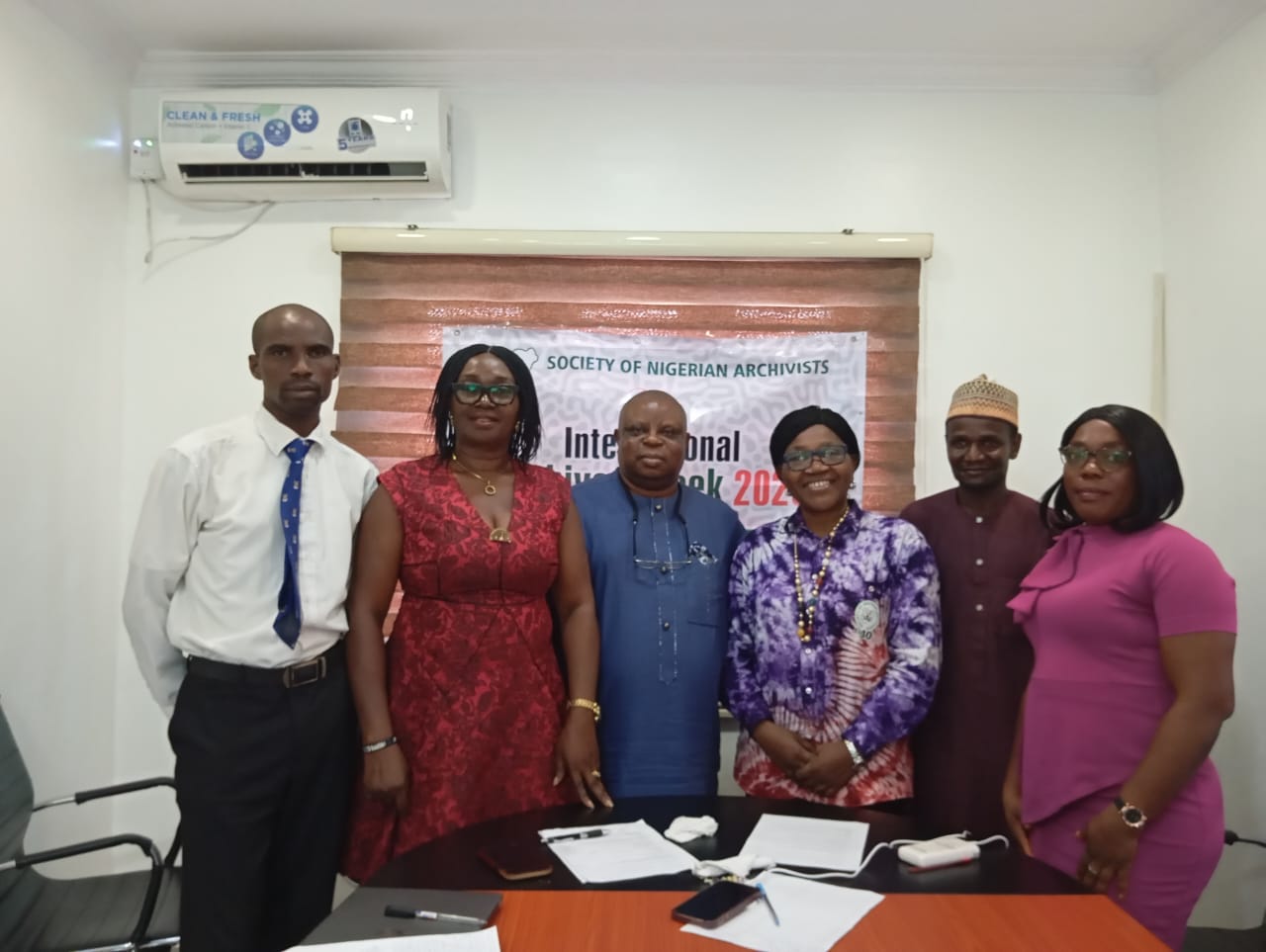
The President of the Society of Nigerian Archivists (SNA), Mrs Yemisi Grace Asaju-Oyebo has urged the Federal Government to review the Nigerian Archives Act of 1992 to meet up with the current challenges in record keeping and information management.
Oyebo, who emphasised that record keeping is relevant to the development of the county, stated that Nigeria should catch up with the current trend in record keeping and management in the world.
The SNA President spoke at a Roundtable Session, which held at Mac Centre at 14, Babatunde Street off Ogunlana Drive, Surulere, Lagos on Wednesday June 11 as part of activities to mark the International Archives Week themed: “Archives Are Accessible, Archives for Everyone.”
Oyebo then urged the Federal Government to review the National Archives Act of 1992, which she said has become obsolete.
“I passionately call on the Federal Government to rescue our national archives. In Abu Dhabi, the National Archives is under the presidency. We need professionals to be employed not for the government to post civil servants to office of archives.
“We have our people that are ready to work. We go through a lot of trainings and so we should have jobs to do. We have manpower in the profession.
“The government has not been too fair to our national archives, they need to come to the aid of the professional act. The National Archives Act was published in 1992 and it is only limited to archives. It needs to be updated for record keeping in Nigeria generally.
“If you go to our national archives, you will be disappointed. The government should help us so that we can develop this and people can keep their records in the national archives. If we have the right tools, we will do it right.
“If we lose our records, what will our children meet. The National Archives should be empowered. Once that is done it would help us a lot.
“We need archaeologists, historians and librarians in our midst. Once you are keeping memories, you keep records, so we need to come together to collaborate to have a professional archiving in Nigeria.
“We want our members to pay their dues, attend meetings and trainings. If you don’t give your contributions it would affect us as a society.
“Families should also turn in their records for safe keeping so that when they are no more other generations can have the records so that they will not go unrecorded,” she stated.
While saying that the future of archival work in Nigeria is bright and beautiful, Oyebo stated that she is optimistic because the society is not quiet, adding that they have people that have the passion for the job.
She recalled that the society woke up from its hibernation after COVID-19, saying that they know what to do if they can get the right backing and empowerment.
According to her, members of the society will soon compete with those in Europe and the Middle East, and stressed that the professionals are thorough, and that they will continue to grow.
“We have been around silently for 40 years, but in the last three years we are voicing out. What we are doing today is a landmark and we have YouTube channel and Instagram so that we will not go into hibernation again.
“The evidences of what people are doing can only be seen in records. We are appealing to our governors, legislators and president that all that we are doing should be recorded. We need leaders that can reason along with us. We are here to help the society for us to get to the apex of record keeping.
“We are collaborating with other heritage keepers so that we can take the country to the highest level in record keeping.
“It might be expensive to get the infrastructure, but it will pay off in the long run. We need professionals that can formulate the right policies, and we need the people and the right infrastructures, governance structure.
“It can only be done with professionals. We want archives to be accessible; both physical and electronic, we need control measures so that people would not be afraid to keep their records.
“We cannot do justice in courts without case files, we cannot attend to patients without records, you need a file for a job and you need records for your businesses. Businesses should incorporate proper record keeping and employ our people right from the beginning of their businesses so that you will not be caught up with government regulations and fines. Be part of SNA and pay your dues,” she said.
On how the SNA support professional archivists, Oyebo stated that they bring professionals from different the academics and business concerns, adding that most of the members of SNA have background in library science and history.
She added that they have taken up young ones from library schools, and that they have the training and curriculum committee where there are professors, while revealing that they have done many webinars.
She said; “We have not been able to carve out a document for our training, but we are looking into it to ensure that our people have training and to see that we have accreditations.
“We have issues of funding, but we are trying to approach corporate bodies to support us with funds. When these are done, we will be able to do more.
“On record keeping in Nigeria: we are putting in our best. But we try to let people know better ways of doing things. In the area of advocacy, we let the people know about record keeping and archiving.
Also speaking, Dr Ifeanyiwa Okafor, the Welfare Secretary of SNA, said that activists and archivists are two different things.
Dr Okafor said that while activists are human rights fighters, archivists are record keepers, saying that many people don’t know how to pronounce the word ‘archivist.’
The SNA Welfare Secretary stressed that there are a lot of mismatches and misinformation about the profession, saying that some people think that everyone can be an archivist.
“You can read any other course and keep records, that does not mean you are an archivist. When I joined Ikoyi Club 1938, I discovered that they didn’t have a proper record keeping method. It took me time to explain to them that there is a difference between archives and data management.
“A professional archivist needs a training in a university or in a professional institution. A lot of things are wrong in the profession that must be corrected.
“People don’t understand what it takes to keep records, they think it is expensive. We need to come up with information for people on how to be archivists.
“Most organisations don’t understand what you are doing, they give you staff, you train them. But after training, they post them to other departments, but I resisted that.
“Without archives there would not be sustainable development. Where there is no good record keeping we will not have governance. It is when information are available that it would lead to development.
“If you don’t have records, you cannot be accountable. People want to see what you have done. You need to consult to achieve equity. We may not be able to access information due to certain things. Without good records you would not have competitive advantage.
“All the things associated with corruption are found in bad governance, which thrives when there are no records,” she said.
In his contribution, Dr. Kolawole Oseni, an ex-officio member of SNA, said that for one to be an archivist, the person must belong to a professional organisation such as SNA.
Dr Oseni stated that this is why the society must ensure that those who want to join the profession are trained, saying thaf that SNA has institutional linkage with the world body, International Council of Archives (ICA).
“Archives is for everybody. There is no way you cannot be part of it because they keep history alive. We are to make things available for people.
“There is need for a comprehensive compilation of the members of SNA. We need to continue to produce the news letter of the association.
“We need ethics for the members like a constitution and guide. There should be a monitoring committee to help the members and design a system where members can get some benefits.
“We need to have friends of SNA such as engineers, lawyers and others who believe in the profession for sustainability. We will have a conference before the end of the year and that can be possible with your contributions, cooperation and encouragement,” he said.
Dr Abdulkareem Aliu Bube, the Vice President of SNA, who lectures at the Ahmadu Bello University, Zaria, Kaduna, in his comments, said that the perception of the northerners with that of the southerners on archivists is the same.
The scholar said that most people cannot pronounce the word ‘archivist’ and that they don’t know the value of the profession, saying that the perception of the people has to be changed in both the north and the south.
“We have the Center for Historical Documentation and Research in Ahmadu Bello University. There, we have the archives department, the museum and the library. You can do research on many notable people in the north there and it is well managed,” he said.
On how archives can contribute to national development, Dr. Bube said that development cannot come without the right information.
He said that archives are the primary sources of information, and that if all government establishments and parastatals have archives managed by professionals, then it would help the nation.
In her closing remarks, Mrs Oyebo said that it is not enough for the people to put all the blames on the government, adding that those in the profession must know their onions and go all out to get their jobs done professionally and convince the people on the benefits of record keeping.
She said; “you have to get certified in the corporate world and go for higher degrees if you are in the academic world. If you have gone for training, you should sell yourself and convince them.
“Can you do your budgeting very well, do you have the charisma to speak with the management. I set up their library in Shell Oil in Warri, Port Harcourt and Lagos, while I was working there. The same thing I did in First Bank and I went round to see that things are properly done. I told my bosses that there would be problems if they didn’t do something fast and that their records could wipe away at once.
“I told them to go digital and as at 2006 they had Electronic Content Management system (ECM) in First Bank. We got certified in 2010 on information audit. I used my personal money to go for conferences.
“Archives can be accessible and it can be made available for others if we want it to be. Let us brace up with AI and technology. You need to train yourself so that you can convince your employers on what you can do. I am where I am today because of my personal training. Understand your business environment and strategy. I told them we needed records and they agreed with me,” she said.
Also at the Roundtable Session was Mr Samson Izekhome Dalumo, who emphasised the need for Nigerians to recognise the job of archivists and give them all the supports they need, saying that Nigeria should catch up with what is happening in other parts of the world on record keeping.




-

 Society News5 years ago
Jamaican man beheads wife after finding out their 6 kids are not his
-
 Society News7 years ago
EXCLUSIVE: The Complete Story of Dolapo Awosika, John Fashanu and Prophet Kasali Sex Mess
-
 News6 years ago
Pastor Osagie Ize-Iyamu, His Membership Of Secret Cult, And Other Issues Touching On His Public Credentials Examined by Barr. PATRICK I. BIOSE
-

 News6 years ago
BREAKING: Ajimobi’s daughter-in-law blast Gov. Makinde, says gov can’t surpass ex-Oyo gov
-

 Society News6 years ago
The Rise and Fall of “Jumoke The Bread Seller”
-

 News6 years ago
BREAKING: 2 arrested as NAF begins investigations into Tolulope’s death
-
 Crime6 years ago
Exclusive: Female Aide Fingered In Oko Oloyun’s Murder + Banking Transactions That Nailed Husband
-

 News5 years ago
BREAKING: Police take over Edo House of Assembly as APC, Oshiomhole move to seize control


You must be logged in to post a comment Login