

Featured
Projection and Vacuousness: The Twin Fault Lines of Amaechi’s Politics


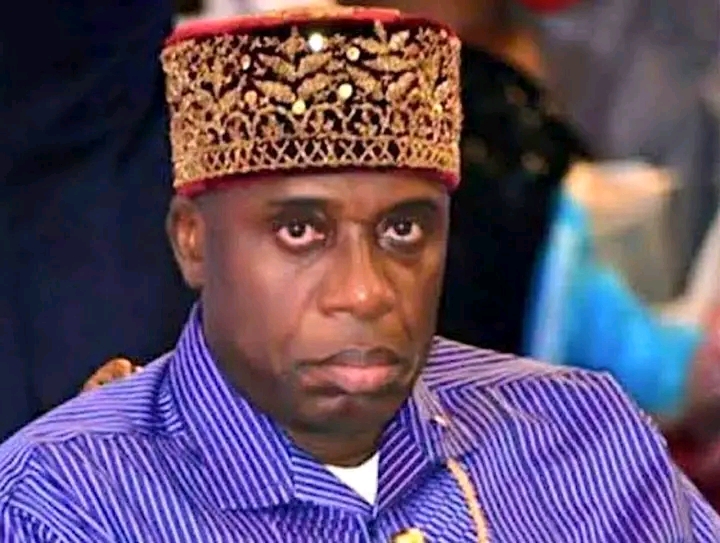
There’s a peculiar affliction in politics—one that convinces a man he’s heavy when he’s light. Rotimi Amaechi, once a formidable force in Nigeria’s power corridors, now seems trapped in that illusion. His recent declaration—“I’ve not had an election against Tinubu”—is not just revisionist; it’s convulsive. It exposes a man so desperate to rewrite his relevance that he’s begun to erase history.
In 2022, Amaechi contested the APC presidential primaries. He was soundly defeated by Bola Tinubu, despite his covert alignment with the so-called “cabal.” That moment was not just a political loss—it was a reckoning. Before and since then, Amaechi has not won any election. His estrangement from Nyesom Wike, once his political anchor, has left him adrift. Yet rather than eat the humble pie, he crafts caricatures of defiance, punctuated by faux pas and rhetorical misfires.
“I don’t like money. I’m hungry,” he once quipped—lines that oscillate between comic relief and tragic self-exposure. His recent claim that he will defeat Tinubu in 2027 if he secures the ADC ticket is steeped in bravado but devoid of substance. “I know his strengths. I know his weaknesses,” he insists. But knowledge is not power when it’s untethered from credibility.
What emerges is a politics of projection and vacuousness—the twin fault lines of Amaechi’s public posture. His rhetoric functions as psychological deflection: accusing others of what he himself embodies—cluelessness, desperation, irrelevance. He calls Tinubu’s government “clueless,” dismisses the coastal road project as “a road for stealing,” and vows to “abandon it” if elected. These are not critiques—they are tantrums. Even if he does not care a fig about the benefits such a once-in-a-generation project will bring to Lagos, the economic heartbeat of Nigeria, what about the mammoth effect on Rivers State and its people? It’s an absurd pronouncement by a once-upon-a-time leader who has completely lost touch with reality.
Meanwhile, Tinubu’s administration, while imperfect—as no one is—continues to deliver the most extensive reform agenda in Nigeria’s democratic history. Just a few among numerous achievements include:
– Foreign reserves have risen to $39.99bn as of August 6, 2025, up from about $4bn when he assumed office
– Oil production has climbed to 1.8mbpd, up from 1mbpd
– A $7bn forex backlog has either been cleared or the unverifiable claims thrashed
– Over 2,000 primary healthcare centers built or revitalized, with a target of 17,000 by 2027
– Oncology centers established in all six geopolitical zones
– Eight additional universities and their teaching hospitals to enjoy uninterrupted power through the Energising Education Programme
– A Diaspora BRIDGE educational programme connects Nigerian professionals abroad with local institutions—turning brain drain into brain gain
– Student loans disbursed to 400,000 students
– MSME support includes:
– ?50bn Presidential Grant Scheme for 1 million nano businesses
– ?75bn MSME Intervention Fund offering single-digit interest loans
– ?75bn Manufacturers Fund enabling access to ?1bn at 9% interest
– MSME Clinics and ?250,000 grants to outstanding small businesses
– A $3bn Eastern rail project in progress—reviving the Port Harcourt–Maiduguri corridor and unlocking billions in regional trade
– Nationwide road construction at unprecedented scale, including the Abuja–Kano road and legacy projects like the Sokoto–Badagry Highway
– Dry season farming and mechanized agriculture expanded; Irrigate Nigeria Project and the Livestock Development Ministry created to boost food production, eliminate herder-farmer conflict, and transform affected communities
These are separate from other monumental reforms such as Local Government Autonomy and Tax Reforms.
All these giant strides have earned validation not just from Nigerians, but from global institutions:
– The World Bank affirms that Tinubu’s reforms are restoring macroeconomic stability
– Moody’s and S&P Global Ratings have upgraded Nigeria’s outlook, citing the reforms as pivotal to reversing fiscal deterioration
Amaechi’s rhetoric ignores these facts. His strategy—like that of many opposition figures—is not built on offering alternatives, but on stoking anger. And that is where it becomes dangerous.
Opposition is vital to democracy. But when it descends into scaremongering, it ceases to be patriotic. It becomes sabotage. Amaechi’s utterances reflect a disregard not just for truth, but for Nigeria’s image and survival. Must you always fight in the mud and drag the country down with you?
The most telling response to Amaechi’s provocations is Tinubu’s silence. It is the silence of a man too focused on rebuilding to be distracted by a provocateur. And perhaps that is the final indictment: when your relevance depends on being noticed, being ignored becomes unbearable.
NOTE: A right of reply is welcome. It can only enrich the discourse. I will publish responses that meet the standards of etiquette and professionalism.
Olabode Opeseitan
Editorial Architect | Steward of Legacy Narratives




-

 Society News5 years ago
Jamaican man beheads wife after finding out their 6 kids are not his
-
 Society News7 years ago
EXCLUSIVE: The Complete Story of Dolapo Awosika, John Fashanu and Prophet Kasali Sex Mess
-
 News6 years ago
Pastor Osagie Ize-Iyamu, His Membership Of Secret Cult, And Other Issues Touching On His Public Credentials Examined by Barr. PATRICK I. BIOSE
-

 News6 years ago
BREAKING: Ajimobi’s daughter-in-law blast Gov. Makinde, says gov can’t surpass ex-Oyo gov
-

 Society News6 years ago
The Rise and Fall of “Jumoke The Bread Seller”
-

 News6 years ago
BREAKING: 2 arrested as NAF begins investigations into Tolulope’s death
-
 Crime6 years ago
Exclusive: Female Aide Fingered In Oko Oloyun’s Murder + Banking Transactions That Nailed Husband
-
 News6 years ago
BREAKING: Police take over Edo House of Assembly as APC, Oshiomhole move to seize control


You must be logged in to post a comment Login