

Crime
Seven Chinese Nationals Jailed For Cyberterrorism, Internet Fraud in Lagos


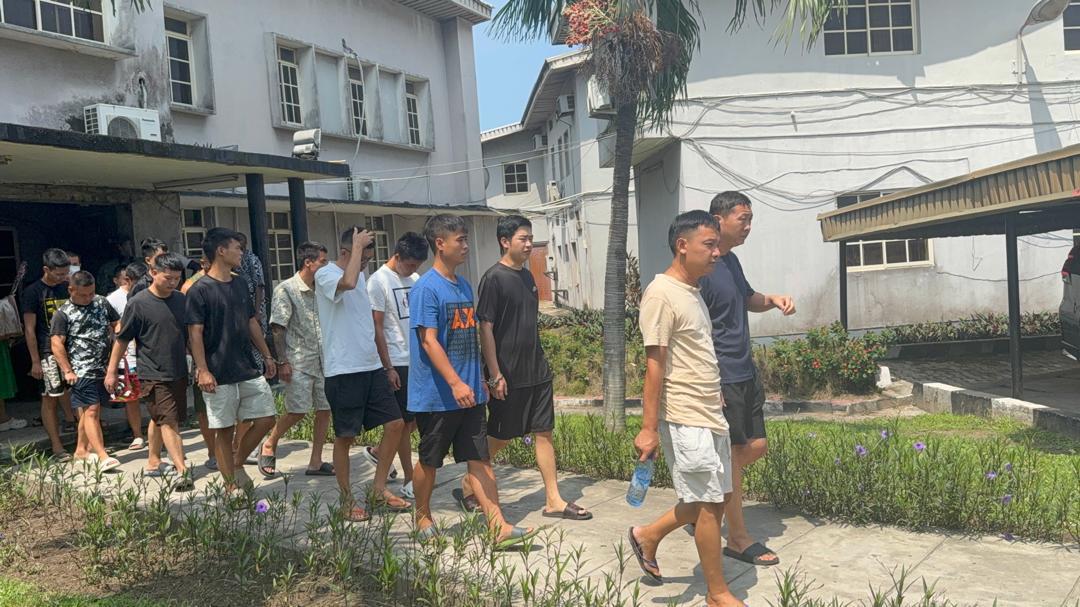
A Federal High Court sitting in Lagos on Friday convicted and sentenced seven Chinese nationals to one year imprisonment each for their roles in a cyberterrorism and internet fraud scheme tied to a large-scale Ponzi operation uncovered in December 2024.
The convicts — Peng Li Huan, Zhang Jin Rong, He Kun, Rachelle Cabalona, Caselyn Pionela, Guo Long Long, and Zhang Hua Zhai — were apprehended by operatives of the Economic and Financial Crimes Commission (EFCC) during a massive raid on a building along Oyin Jolayemi Street, Lagos. The operation led to the arrest of over 700 individuals linked to the syndicate.
They were arraigned separately before Justices Ayokunle Faji, Chukwujekwu Aneke, and Yellim Bogoro of the Federal High Court on one-count charges bordering on cyberterrorism and internet fraud.
Prosecuting counsel — Bilkisu Buhari-Bala, Chineye Okezie, and Banjo Temitope — informed the court that the defendants had entered into plea bargain agreements with the Commission, filed on June 20, 2025.
Each defendant pleaded guilty to the charges and confirmed that they voluntarily consented to the terms of the plea deals.
In their rulings, the judges convicted and sentenced all seven individuals to one year imprisonment each, with an option of ?1,000,000 (One Million Naira) fine.
The court also ordered the Comptroller-General of the Nigerian Immigration Service (NIS) to ensure the deportation of the convicts to their respective countries within seven days of completing their prison terms.
According to the amended charge read in court, the convicts had “willfully accessed computer systems organized to destabilize and destroy the fundamental economic and social structure of Nigeria by recruiting Nigerian youths to commit identity theft and impersonate foreign nationals for financial gain.”
Their offences contravene Section 18 of the Cybercrimes (Prohibition, Prevention, etc.) Act, 2015 (as amended in 2024), and Section 2(3)(d) of the Terrorism (Prevention and Prohibition) Act, 2022.










-

 Society News5 years ago
Jamaican man beheads wife after finding out their 6 kids are not his
-
 Society News7 years ago
EXCLUSIVE: The Complete Story of Dolapo Awosika, John Fashanu and Prophet Kasali Sex Mess
-

 News6 years ago
Pastor Osagie Ize-Iyamu, His Membership Of Secret Cult, And Other Issues Touching On His Public Credentials Examined by Barr. PATRICK I. BIOSE
-

 News6 years ago
BREAKING: Ajimobi’s daughter-in-law blast Gov. Makinde, says gov can’t surpass ex-Oyo gov
-

 Society News6 years ago
The Rise and Fall of “Jumoke The Bread Seller”
-

 News6 years ago
BREAKING: 2 arrested as NAF begins investigations into Tolulope’s death
-

 Crime6 years ago
Exclusive: Female Aide Fingered In Oko Oloyun’s Murder + Banking Transactions That Nailed Husband
-

 News6 years ago
BREAKING: Police take over Edo House of Assembly as APC, Oshiomhole move to seize control

You must be logged in to post a comment Login