

Education
In His Foreword To A Book: Olukoyede Says, ‘There’s Need To Confront Culture That Glorifies Corruption


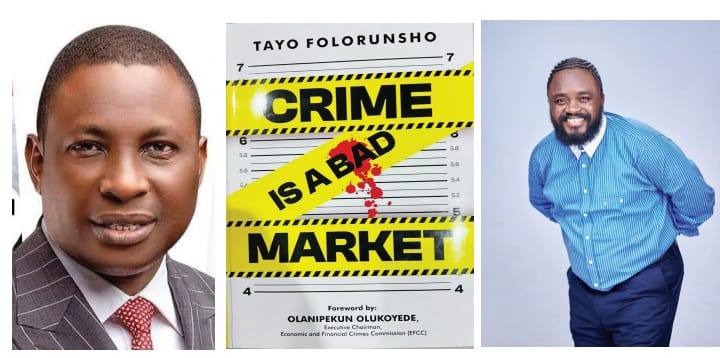
The Chairman of the Economic and Financial Crimes Commission (EFCC), Mr Ola Olukoyede, has drawn a fresh battle line in Nigeria’s long war against corruption, declaring that the struggle goes far beyond arrests and prosecutions to confront the beliefs and attitudes that make crime seem acceptable.
According to him, economic and financial crimes do not flourish merely because laws are weak or institutions fail, but because society has, over time, tolerated ideas and narratives that portray wrongdoing as smart, profitable, and even admirable.
Olukoyede disclosed this in his Foreword to a new compelling and incisive book titled “Crime Is a Bad Market”. The book is written by a Nigerian media entrepreneur, edutainment strategist and youth development advocate, Mr Tayo Folorunsho.
According to Olukoyede, the message in the book aligns directly with the core mandate of the EFCC and reinforces the agency’s evolving approach to tackling corruption at its roots.
The EFCC boss also stressed that the commission has always viewed its responsibility as deeper than law enforcement, saying there is the need to break the menace of corruption for positive growth of the economy.
He said, “The Commission is focussed on breaking the siege of corruption to stimulate growth in the economy. The EFCC has long understood that the fight against economic and financial crimes is not merely a legal obligation; it is a moral crusade. Our battle is not only against offenders but against the ideas, narratives, and cultural mindsets that make wrongdoing appear rational, even aspirational.”
Olukoyede further argued that national decline is rarely sudden, noting that it is often the outcome of repeated moral compromises that eventually become normalised. He explained that criminal acts usually begin long before they attract the attention of investigators.
He further said, “It is an obvious fact that nations do not decline suddenly; they decline gradually, choice by choice, value by value, compromise by compromise. Long before a crime appears on the radar of law enforcement, it begins as a quiet negotiation within the human mind: a moment where principle is weighed against profit, and discipline is traded for desire. “Crime Is a Bad Market” is a compelling illumination of this hidden battleground.”
Olukoyede said the book arrives at a time when shortcuts to wealth have gained dangerous appeal and illicit success is too often celebrated in public spaces. He described the work as a timely counterweight to a culture that rewards excess without questioning its source.
“In a society where the allure of shortcuts has become dangerously attractive, and where the false glamour of illicit wealth is often celebrated, this book provides a profound philosophical antidote”, he said.
The EFCC boss added that the author dismantles the illusion of quick gain and exposes the long-term cost of unlawful behaviour, both to individuals and to the nation.
The anti-graft czar further stated that the book “exposes the deception behind easy gain and demonstrates, with clarity and conviction, that every unlawful profit is a future loss disguised as success. Crime may appear to offer advantage in the moment, but it always destroys more than it delivers: reputation, peace, purpose, and ultimately, one’s destiny.”
Beyond condemnation, Olukoyede said the book reframes integrity as a practical and profitable choice, rather than a moral burden. According to him, it challenges the notion that honesty is a disadvantage in modern society.
He said, “What this book offers is a reorientation of thought: a return to the foundational truth that integrity is not just virtuous but profitable, that honesty is not weakness but strength, and that a nation’s future is secured not only by the enforcement of laws but by the elevation of values.”
Olukoyede noted that “Crime Is a Bad Market” goes beyond figures, case files, and enforcement strategies to interrogate the deeper origins of criminal behaviour. In his view, corruption often takes root far from government offices.
“Crime Is a Bad Market” moves beyond statistics and enforcement to explore the psychological, social, and cultural origins of criminal behaviour.
It reminds us that corruption does not begin in government offices; it begins in the formative spaces: homes, schools, peer groups, and personal ambitions, where the human spirit learns what to prize and what to reject. In this sense, the book speaks directly to the heart of preventive governance, which is at the core of the EFCC’s mission.”
The EFCC chairman said he was particularly drawn to the book’s emphasis on redemption and renewal, noting that it offers hope rather than despair.
He said, “I am particularly inspired by the book’s message of redemption. It does not merely condemn wrongdoing; it offers a pathway to renewal, progress, and national rebirth. It challenges every reader (young or old, privileged or struggling) to align their lives with integrity and to see wealth not as the accumulation of things but as the cultivation of character, peace, and purpose.”
Olukoyede also described the book as timely, especially at a period when nations are increasingly defined by the strength or weakness of their moral foundations. He said the work complements the EFCC’s broader vision of a Nigeria where accountability is collective and honest labour regains its dignity.
He said, “In an era where nations rise or fall on the strength of their moral foundations, this work could not be more timely. It serves as a powerful companion to the EFCC’s efforts to build a corruption-free Nigeria, where accountability is a shared responsibility and where the dignity of honest labour is restored.”
He commended the author for producing what he described as a rare and thought-provoking contribution to national discourse, urging Nigerians across sectors to engage with its message.
“I commend the author for producing a work of rare insight, one that speaks to the intellect, awakens the conscience, and calls every Nigerian to a higher standard of citizenship. I recommend “Crime Is a Bad Market” to policymakers, educators, leaders, youth, and all who seek to contribute to the rebuilding of our national values.”
Olukoyede expressed hope that the book would spark conversations across the country and inspire a shift in mindset, particularly among young people.
“May this book ignite conversations, reshape mindsets, and inspire a new generation committed to integrity as a way of life,” he added.
About the Author
Tayo Folorunsho (Teeflo) — the author of Crime is a bad market — is the Founder of Edutainment First International Ltd/GTE, using education-driven entertainment to empower young people.
He also created “The Big Break Moment Africa”, a platform for discovering and showcasing student talent across Africa.
In 2025, he launched “You Against Crime International”, a civic initiative focused on non- kinetic approach that’s aimed at combating crime and creating awareness round universities and colleges in Nigeria.




-

 Society News5 years ago
Jamaican man beheads wife after finding out their 6 kids are not his
-
 Society News7 years ago
EXCLUSIVE: The Complete Story of Dolapo Awosika, John Fashanu and Prophet Kasali Sex Mess
-

 News6 years ago
Pastor Osagie Ize-Iyamu, His Membership Of Secret Cult, And Other Issues Touching On His Public Credentials Examined by Barr. PATRICK I. BIOSE
-

 News6 years ago
BREAKING: Ajimobi’s daughter-in-law blast Gov. Makinde, says gov can’t surpass ex-Oyo gov
-

 Society News6 years ago
The Rise and Fall of “Jumoke The Bread Seller”
-

 News6 years ago
BREAKING: 2 arrested as NAF begins investigations into Tolulope’s death
-

 Crime6 years ago
Exclusive: Female Aide Fingered In Oko Oloyun’s Murder + Banking Transactions That Nailed Husband
-

 News6 years ago
BREAKING: Police take over Edo House of Assembly as APC, Oshiomhole move to seize control


You must be logged in to post a comment Login