

Featured
Remarkable Strides In Solid Minerals Sector


By Segun Ayobolu
The continuing easing of the biting inflationary spirals in the prices of essential needs caused by the removal of fuel subsidy by the President Bola Tinubu administration. The noticeable increase in food productivity despite persisting insecurity constraints. The sustained positive outlook in the country’s surplus trade balances across successive quarters. The maintenance of a stable exchange rate with the Naira even gradually strengthening through the deft monetary policy. The renewed investor interest and confidence in the country’s economic potentials as reflected in the resurgence of the Nigerian stock market. The considerable amplification of the country’s foreign reserves compared to its parlous state as at May 2003. All these are responsible for the emergent consensus among experts that the far-reaching economic reforms of the administration are gradually yielding the desired results.
Of course, there is still a considerable path to tread before positive statistical aggregates begin to reflect in the quality of life of the vast majority of citizens. The central goals of the economic reforms are to restructure and diversify the economy, significantly enhance domestic productivity, reduce food, technology and other forms of dependency, boost raw materials self-reliance and enhance accelerated industrialization, actualize revenue generating capacities to fund the radical expansion and modernization of infrastructure as well as provision of qualitative but affordable social services including education, healthcare, potable water, efficient transportation as well as sufficient power supply among others.
In the final analysis, the ultimate verdict on the fundamental reforms of the Tinubu administration will depend on the level of performance of Ministries, Departments and Agencies that touch on the lives of millions of ordinary Nigerians, such as agriculture, rural development, education, healthcare, livestock production, poverty alleviation, trade and industry, transportation, as well as roads and infrastructure. But no less critical in this regard is the Ministry of Solid Minerals Development, whose revenue- generating potentials remained largely dormant until the advent of the current administration.
Experts have, over the years, noted that the excessive reliance on revenues from crude oil sales and the lack of investment in developing the myriad of solid minerals that dot vast swathes of the Nigerian geographical space have been factors in the persistent deepening of underdevelopment and poverty in post-colonial Nigeria. In the current dispensation, this narrative of neglect and marginalisation of such a critical sector is slowly but steadily changing. Even then, it is still ‘morning yet on creation day’ even though the portents are quite promising.
The foremost expert on the political economy of solid minerals and underdevelopment in Nigeria, Professor Chibuzo Nwoke, has exhaustively documented the country’s treasure trove of assorted solid minerals spread in diverse locations. He classified them into seven broad categories, namely building and construction industry minerals; fuel minerals; steel industry minerals; non-ferrous minerals; industrial and manufacturing minerals; strategic minerals and precious metals and gemstones. The significance and spread of these minerals underscore the indispensable role of solid minerals in the quest for accelerated industrialisation and modernisation of Nigeria.
As an online medium puts it to illustrate how vital solid minerals are to national development, “Tin, Lead, and Zinc are essential base metals used in various industries, from manufacturing to construction. These are the building blocks of modern infrastructure. Iron ore is a key ingredient in steel production, vital for infrastructure development and industrial growth. This is the backbone of industrialisation. And in the words of Professor Nwoke, “Before the so-called oil boom era in the Nigerian economy, tin mining was the major source of revenue and foreign exchange for the country, which, for a long time, was among the top six producers of both tin and columbite in the world. But more recently, mostly because of the concentration on oil, the importance of tin and other minerals has declined in the Nigerian economy.”
He continued, “A poor mono-cultural Third World country like Nigeria cannot, however, afford to ignore the solid minerals sector of its economy because the long term well-being of the country may very well depend upon the nationalist management of its mineral potentials.
Investigations from the Ministry of Mines reveal that there are potentials in Nigeria’s minerals sector that, if judiciously worked, could provide the needed precondition for a future of industrialisation.”
More than at any other time since the commencement of the Fourth Republic in 1999, a concerted effort had been sustained over the last two and a half years to lay the foundation for the transformation of the solid minerals sector into the backbone for the realisation of the goals of rapid industrialisation and accelerated development.
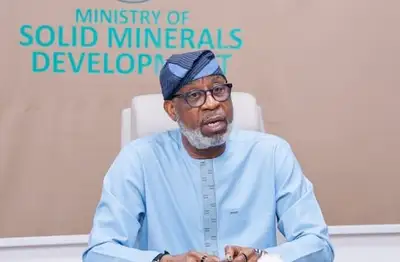
As I wrote in this space on Saturday, June 8, 2024, titled ‘Alake, solid minerals and national development,’ “Dr Oladele Alake is serving as Minister of Solid Minerals Development at a critical transitional phase in the evolution of the Nigerian economy. Not only has the price of crude oil plummeted calamitously in the international market, but many countries are moving away from dependence on fossil fuels for cheaper and safer sources of energy. Many experts assert that the golden age of oil is over and that current reserves of the commodity have a limited lifespan. Alake thus has his work cut out for him. His challenge is to lay the foundation for solid minerals, with which the country is munificently blessed, to become the future major revenue earner for Nigeria.”
On assumption of office, the Minister identified eight priority minerals for immediate action and attention. This was obviously for the specificity of purpose as well as to ensure judicious utilisation of scarce resources to achieve concrete and measurable goals as regards minerals of the highest potential. The targeted eight priority minerals are gold, baryte, iron-ore, lead/zinc, coal, limestone, bitumen and lithium. As I wrote in the earlier piece, “His energies are thus centred on undertaking regulatory reforms to restore investor confidence and renewed global interest in these priority solid mineral resources without necessarily eschewing interest and investment in scores of other minerals with which the country is blessed.”
It is significant that over the years, experts have identified a lack of adequate information on the variety and depth of the country’s solid minerals endowment as a key factor in the continued underdevelopment of the sector to the detriment of national progress and transformation. The entering into an agreement by the Ministry of Solid Minerals with a German firm, Geo Scan Gmbn through a Memorandum of Understanding (MOU) to generate critical data on the eight priority minerals and their deposits thus marks a notable milestone in the evolution of the sector. Towards this end, sophisticated technology has been deployed with the capacity of exploring mineral resources up to 10,000 meters underground.
In a related vein, the Ministry has worked in concert with the World Bank to conduct aeromagnetic surveys across the country for more accurate and reliable data on mineral spread and deposits to enable investors make more informed investment decisions. As the Minister noted at the 2024 Mines and Mining Conference in London, “The country’s geographical bounty encompasses over 44 distinct mineral types, found in exploitable quantities across more than 500 locations.” This expansive solid minerals endowment has also spurred Dr Alake to take defining and decisive steps to tackle the widespread incidence of criminality and violence associated with illegal mining in the largely ungoverned spaces where substantial quantities of solid minerals deposits are located.
The unveiling on March 22, 2024, of the 2,200-strong Mines Marshall Corp drawn from officers and men of the National Security and Civil Defense Corp (NSCDC) marked the most elaborate effort in the history of the ministry to restore sanity and legality to the mining of solid minerals in Nigeria. With the Corps’ command and control centre located in the Ministry of Solid Minerals Development, the Mines Marshal Corps is functional in all mining sites across diverse states, where it executes its mandate to smoke out, thwart and apprehend illegal miners and other violators of the country’s mining laws in the interest of Justice.
Nothing illustrates better the efficacy of the reforms vigorously undertaken over the last two years by Alake in the solid minerals sector than the quantum leap in the ministry’s financial contributions to the national coffers under his leadership. For 2023, the Ministry of Solid Minerals generated approximately N16 billion in revenue, and this amount rose to N38 billion in 2024. Between January and November 2025, the revenue generated by the ministry had hit N63.92 billion within 11 months, and the Ministry is optimistic that the total revenue figure for 2025 will exceed the N70 billion mark. This represents a growth rate of over 337% from the 2023 figure of N16 billion.
This astronomical increase in the Ministry’s revenue performance has been attributed to such reform initiatives as the revocation of dormant mining licences by the Minister, the drastic tackling of illegal mining through the Mining Marshalls Corp and initiatives aimed at enhancing local value addition before export of solid minerals, as well as attracting foreign investment. Shortly after resumption of office, the Minister announced the revocation of 1,633 mining licences due to default in the payment of their stipulated annual service fees. The affected entities had exceeded their deadlines to offset their debts as demanded by the Mining Cadastral Office, and they retrieved their licenses only after defraying their debts.
The digitisation of mining license applications has enabled online mining license processing, thereby increasing transparency and accountability with positive revenue generation implications. While a substantial amount of about N1 trillion was allocated for mineral exploration to bridge data gaps, over 300 artisanal mining cooperatives were formalized and these in turn stimulated better effectiveness, efficiency and organisational dynamism in the ministry. In the same vein, the launch of the Nigeria Minerals Decision Support System (NMRDSS) has improved access to geological data and the attraction of investors. Also noteworthy are the MOUs entered into with reputable firms in the United Kingdom and Australia for the training of Nigerian mining professionals on modern mining technology and practices.
In an address to a mining conference organized by the Nigerian Institute for Policy and Strategic Studies ( NIPSS), Alake had unequivocally declared that “My objective as the Minister is to work to ensure that Nigeria becomes a global mining destination for the first time in history and we are working to make this happen by alleviating bottlenecks and addressing salient challenges that have plagued the sector for decades”. The election of Alake as Chairman of the African Minerals Strategy Group (AMSG) in 2024 reflects the Ministry’s active participation on the global terrain, the amplification of its influence and the positive ramifications for the attraction of foreign investment and consequently enhanced financial viability.
From all indications, the Ministry is not resting on its oars as its leadership believes that the strides taken so far, though by all means remarkable, represent a minuscule portion of the potentials of the sector and the far greater heights it is still possible to attain.




-

 Society News5 years ago
Jamaican man beheads wife after finding out their 6 kids are not his
-
 Society News7 years ago
EXCLUSIVE: The Complete Story of Dolapo Awosika, John Fashanu and Prophet Kasali Sex Mess
-

 News6 years ago
Pastor Osagie Ize-Iyamu, His Membership Of Secret Cult, And Other Issues Touching On His Public Credentials Examined by Barr. PATRICK I. BIOSE
-

 News6 years ago
BREAKING: Ajimobi’s daughter-in-law blast Gov. Makinde, says gov can’t surpass ex-Oyo gov
-

 Society News6 years ago
The Rise and Fall of “Jumoke The Bread Seller”
-

 News6 years ago
BREAKING: 2 arrested as NAF begins investigations into Tolulope’s death
-

 Crime6 years ago
Exclusive: Female Aide Fingered In Oko Oloyun’s Murder + Banking Transactions That Nailed Husband
-

 News6 years ago
BREAKING: Police take over Edo House of Assembly as APC, Oshiomhole move to seize control


You must be logged in to post a comment Login