

Featured
Fact Check: No, Nigeria’s 2026 Tax Reform Does Not Tax The Poor • It Leaves More Money In Their Pockets


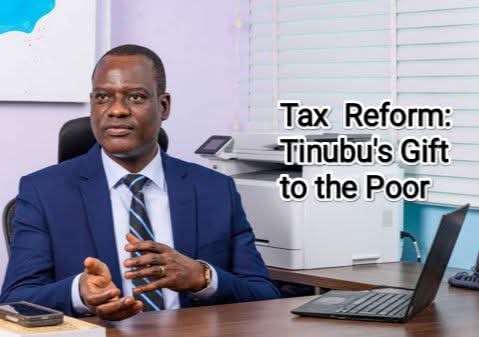
By
Olabode Opeseitan
How does a writer of evident intellect, claiming ex-World Bank credentials, channel his time and talent into crafting falsehoods designed to incite mass disaffection, rather than illuminate truth for societal good?
Emmanuel Orjih’s viral essay on Nigeria’s new tax laws exemplifies this: it alleges President Tinubu’s tax reforms he called “Bola’s Tax” forces low earners like 20-year-old “Joseph” (N75,000 monthly village wage) into income tax, proving “Nigeria’s poor are about to start paying taxes.”
Most claims are either fabricated anecdotes or exaggerated distortions that collapse against the actual laws, as clarified by Taiwo Oyedele, chair of the Presidential Fiscal Policy and Tax Reforms Committee.
Far from burdening the vulnerable, the policy exempts them entirely, delivering more take-home pay than the old system, and targets high-end evasion to fund essential services like roads and schools.
Claim 1: Joseph on N75,000 Pays Tax After Pension, Proving the Poor Now Owe Income Tax
Orjih recounts grilling FIRS officials at an Abuja event, where they allegedly U-turned to admit Joseph’s N75,000 salary (minus 8% pension = N69,000 taxable) falls into a tax bracket under the new rules. It’s a compelling anecdote: subsistence youth dragged into the net.
The Reality: This math ignores the reform’s foundational exemptions. The tax laws establish a zero-tax band up to N800,000–N1.2 million annually (N67,000–N100,000 monthly), explicitly shielding national minimum wage earners (N70,000) and those slightly above after consolidated reliefs: 20% of gross income plus fixed allowances for housing, transport, and dependents.
Oyedele has clarified: low earners like Joseph pay no PAYE or less than before, with 98% of Nigerian workers seeing higher net pay due to scrapped nuisance taxes and expanded reliefs.
Joseph’s full salary stays in his pocket, with actually more disposable income than under prior uneven collections. The “U-turn” is a fabrication born of selective arithmetic.
Claim 2: Everyone Earning Under N190,000 Monthly Is “Poor”, So Taxing Them Hits the Vulnerable
Orjih invokes World Bank authority (he’s ex-staff) to define poverty at $4.20/day, converted to “approximately N190,000 per month.” Since Joseph earns N75,000, he’s poor, and taxing him indicts the policy.
The Reality: Orjih’s N190,000 derives from abusing parallel market rates ($126 × N1,450 = N183k, rounded up), a deliberate distortion. This is methodologically wrong because World Bank poverty lines use Purchasing Power Parity (PPP) conversion factors, not black market exchange rates. PPP accounts for what money actually buys locally, not forex speculation. Nigeria’s 2023 PPP factor (N519/int’l $) yields N65,375/month, or N75,000 with 2025 inflation. NBS national poverty line: N52k-N55k/month (2025-adjusted).
By expanding “poor” to include lower-middle earners (N75k-N190k), Orjih manufactures outrage where 50+ exemptions shield micro-businesses (N25M-N100M turnover), farmers, and low-wage salarymen.
Claim 3: “Widening the Tax Base” Means Reaching Down to the Poor, the Wealthy Already Pay
With elites “long in the net,” Orjih argues expansion can only mean “the poor, livestock, or ghosts”, and we know which.
The Reality: Official documents target non-compliant high earners, digital platforms, luxury assets, and untaxed sectors, not village gardeners. Personal income rates stay progressive (0–25%), with reliefs pushing most into zero/low bands. No across-the-board hikes; instead, simplification eliminates levies hitting informal workers.
Europe funds gleaming roads and schools from broad bases, Nigeria builds toward that without evasion culture, exempting the vulnerable while formalizing elites.
Claim 4: High Inflation and 9 Economic Ills Make This “National Economic Suicide”
Orjih lists inflation, unemployment, and weak growth as barring any tax shift, warning of shrinking compliance and deepened poverty.
The Reality: Inflation has plunged from 33.88% (mid-2025 peak) to 14.45% (Nov 2025), the lowest in over three years, thanks to harvests and naira stability.
Reforms launch amid improvement, not crisis. Globally, governments tax progressively to deliver services; Nigeria’s version boosts low earners’ pockets (per Oyedele) while curbing leakages, fostering growth and trust through visible delivery by February–March 2026.
Orjih’s essay sows doubt with emotional stories and bad math, but the new tax reforms advance fairness: protects the poor, funds public goods, and counters evasion.
Low-wage Nigerians will soon see unchanged, or higher payouts, proving policy over propaganda.
#tax
#TaxReform
#Nigeria
#poverty
#RenewedHope




-

 Society News5 years ago
Jamaican man beheads wife after finding out their 6 kids are not his
-
 Society News7 years ago
EXCLUSIVE: The Complete Story of Dolapo Awosika, John Fashanu and Prophet Kasali Sex Mess
-

 News6 years ago
Pastor Osagie Ize-Iyamu, His Membership Of Secret Cult, And Other Issues Touching On His Public Credentials Examined by Barr. PATRICK I. BIOSE
-

 News6 years ago
BREAKING: Ajimobi’s daughter-in-law blast Gov. Makinde, says gov can’t surpass ex-Oyo gov
-

 Society News6 years ago
The Rise and Fall of “Jumoke The Bread Seller”
-

 News6 years ago
BREAKING: 2 arrested as NAF begins investigations into Tolulope’s death
-
 Crime6 years ago
Exclusive: Female Aide Fingered In Oko Oloyun’s Murder + Banking Transactions That Nailed Husband
-

 News6 years ago
BREAKING: Police take over Edo House of Assembly as APC, Oshiomhole move to seize control


You must be logged in to post a comment Login