

Featured
THE METHUSELAH PRESIDENCY: PAUL BIYA AND THE DECAY OF A NATION


By Marshall Israel, Public Affairs Analyst
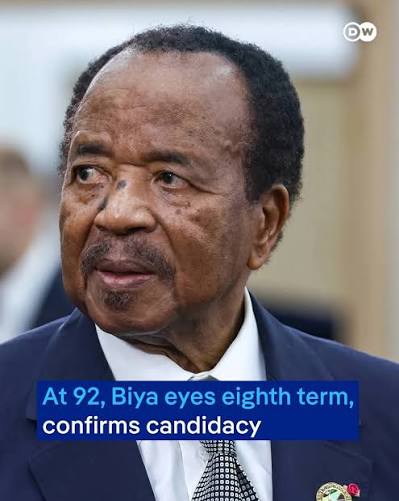
For more than four decades, President Paul Biya has ruled Cameroon with the endurance of a monarch and the detachment of an emperor — presiding over one of the longest and most stagnant regimes in modern African history. At 92, he stands not as a symbol of wisdom or continuity, but as the embodiment of a political system that has refused to evolve — a leader whose extended stay in power has become both a national tragedy and a continental embarrassment.
The official results of the October 12, 2025 presidential election declared Biya the winner with 53.66 % of the vote. His main challenger, Issa Tchiroma Bakary, garnered 35.19 % and rejected the outcome, citing widespread irregularities. With this controversial victory, Biya begins his eighth term — a mandate that could keep him in office well into his 100th year if completed.
1.Faded hope, economic decay
When Biya assumed power in 1982, Cameroon was filled with hope. Four decades later, that hope has dissolved into silence — a silence marked by poverty, fear, and disillusionment.
Despite being resource?rich, including iron ore, gold, bauxite and cobalt, Cameroon’s GDP growth has lagged population growth, and poverty reduction has stagnated.
Business climate is weighed down by bureaucratic hurdles, corruption, and weak rule of law: entrepreneurs and SMEs face expensive and opaque permit and tax regimes.
The latest official economic report (2024) notes that while some reforms have occurred, critical structural issues remain: weak property rights systems, inefficient and under-resourced judiciary, and low transparency in the public sector.
The region of the Far North is particularly affected: some areas report poverty rates vastly above the national average.
On the macroeconomic front: the region of the Economic and Monetary Community of Central Africa (CEMAC) – of which Cameroon is a part – faces deteriorating net external reserves, declining oil production and heavy external debt. Biya warned of “disastrous consequences” if nothing is done.
Public infrastructure has crumbled, unemployment run high, corruption has become institutionalized — these are not by?products but embedded in the system.
2.Legislative and institutional decay
The decay is not only economic — it is deeply embedded in the country’s legislative and judicial frameworks.
The legislative body (the National Assembly) and the Senate (Cameroon) are overwhelmingly dominated by the ruling party (the Cameroon People’s Democratic Movement – CPDM), which holds 139 of 180 seats in the National Assembly and 95 of 100 in the Senate.
Major constitutional reforms (such as the removal of presidential term?limits) passed with near-unanimous support from a compliant legislature.
Decentralization enshrined in law has not translated into real local power: though constitutional provisions exist, regional and local bodies remain heavily controlled by appointed governors and divisional officers loyal to the presidency.
The legislature has failed to provide meaningful oversight of the executive; demands for investigative commissions are routinely blocked and opposition representation is minimal.
3.Judicial capture and erosion of the rule of law
A fully functioning judiciary is essential for democracy — but in Cameroon, the judiciary is widely regarded as subservient to the executive.
The judiciary is widely perceived as politically controlled, with the president chairing the Higher Judicial Council, controlling promotions, transfers and dismissals of judges, undermining their independence.
Courts suffer from severe resource constraints: understaffed, poor physical conditions, materials lacking, archives in bad shape.
In cases of financial misconduct, special courts like the Special Criminal Court have been criticised for being used selectively against political rivals rather than rooted in consistent rule of law.
The result: citizens have limited recourse to justice; corruption continues unchecked; the judiciary does not serve as a genuine check on executive excess.
4.France’s complicity in the system
The role of France in sustaining Cameroon’s regime is substantial and multifaceted — economic, monetary, political and military.
Monetary control: Cameroon uses the CFA Franc (Central African Franc) via the CEMAC zone. The CFA is pegged to the euro, and about half of CFA states’ foreign exchange reserves must be lodged with the French Treasury — giving France effective control over monetary policy.
Economic influence: French companies dominate key sectors in Cameroon; trade with France and French?controlled developmental loans reinforce economic dependence and extraction of value rather than local benefit.
Political and security backing: France has provided military aid to Cameroon (including for counter-terrorism operations) and diplomatic cover for the Biya regime, enabling the long stay in power despite transgressions.
Historical legacy and repression: France has formally acknowledged its role in violent repression of Cameroun’s independence movements (1945-1971) – a diploma of complicity in the structures of authoritarian control.
In short, France’s continued engagement has helped maintain the status quo: a dependent economy, weakened institutions, and a regime with little incentive or capacity to reform.
5.The moral and democratic tragedy
The tragedy of Cameroon is not merely economic; it is moral and democratic. Biya’s regime has systematically dismantled every instrument of accountability. Elections are manipulated, dissent is criminalized, opposition figures routinely harassed or jailed. Independent journalists are silenced; civic voices suppressed; the rule of law subverted to preserve impunity.
The Anglophone Crisis stands as one of the darkest legacies of Biya’s rule. What began as demands for equity and inclusion spiraled into armed conflict after the government chose force rather than dialogue. Thousands have been killed, villages razed, entire communities displaced — what could have been a conversation about inclusion became a brutal war of attrition.
Biya’s long absences from the country — often governing remotely from foreign luxury suites — only deepen the alienation of his people. While Cameroonians queue for bread and struggle to access healthcare, their president lives in opulence abroad, detached from the daily suffering of his nation. This moral disconnect epitomises the leadership crisis suffocating Cameroon.
6.But the future must not end with Biya
Yet, Cameroon’s future must not end with Biya. The nation’s destiny lies in democratic renewal — in a peaceful transition that restores dignity, accountability, and hope. The country’s young population, vibrant civil society, resilient spirit deserve a government that listens, reforms, and serves rather than rules by fear.
The international community, the African Union, and regional blocs such as the Economic and Monetary Community of Central Africa (CEMAC) can no longer treat Biya’s rule as an “internal affair.” Democracy is not a privilege; it is a universal right. The world must stand with Cameroonians in their quest for freedom — through targeted sanctions on corrupt officials, diplomatic pressure for credible elections, and robust support for human-rights defenders.
Africa cannot progress while its oldest autocrats cling to power through manipulation and fear. Leadership should be measured not by longevity, but by legacy — not by years in office, but by the lives transformed.
Paul Biya may be the Methuselah of Africa, but his prolonged reign should serve as a warning, not a model. The time has come for the world to say, clearly and without hesitation: enough is enough. Cameroon deserves a new dawn — one built on justice, democracy, and freedom.




-

 Society News5 years ago
Jamaican man beheads wife after finding out their 6 kids are not his
-
 Society News7 years ago
EXCLUSIVE: The Complete Story of Dolapo Awosika, John Fashanu and Prophet Kasali Sex Mess
-
 News6 years ago
Pastor Osagie Ize-Iyamu, His Membership Of Secret Cult, And Other Issues Touching On His Public Credentials Examined by Barr. PATRICK I. BIOSE
-

 News6 years ago
BREAKING: Ajimobi’s daughter-in-law blast Gov. Makinde, says gov can’t surpass ex-Oyo gov
-

 Society News6 years ago
The Rise and Fall of “Jumoke The Bread Seller”
-

 News6 years ago
BREAKING: 2 arrested as NAF begins investigations into Tolulope’s death
-
 Crime6 years ago
Exclusive: Female Aide Fingered In Oko Oloyun’s Murder + Banking Transactions That Nailed Husband
-

 News6 years ago
BREAKING: Police take over Edo House of Assembly as APC, Oshiomhole move to seize control


You must be logged in to post a comment Login