




By Olabode Opeseitan
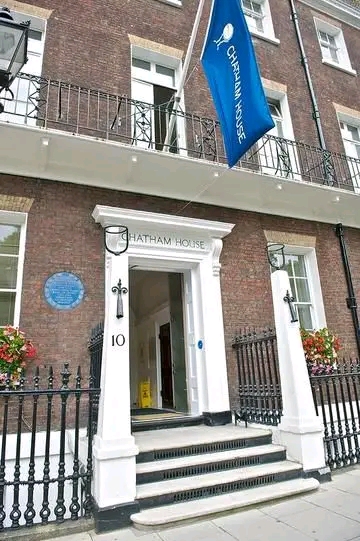
On certain mornings in London, when the fog hangs low over St. James’s Square and the air carries that faint metallic chill peculiar to the city, a familiar procession unfolds. Nigerian politicians, decked in tailored coats and the quiet tension of ambition, step out of black cars and walk toward the Georgian façade of Chatham House. They move with the solemnity of pilgrims approaching a shrine. For decades, this building has been treated as an altar of influence, a place where Nigerian leaders go to kiss the ring of international validation.
Hardly has there been any electoral cycle in Nigeria when its aspiring leaders do not rush to Chatham House to speak at its shrine of sway and seek its endorsement. The ritual persists even as the oracle itself has grown increasingly unreliable.
The irony is that the institution so revered by Nigerian elites has a long history of getting the world wrong.
Chatham House once enjoyed a reputation for sober analysis and intellectual rigor. Today, it resembles an institution that has forgotten how to read the world it claims to interpret. Its recent assertion that President Bola Tinubu’s international diplomacy has had “no impact” on the lives of Nigerians is only the latest entry in a catalogue of analytical misfires. The critique, published this month under the title “Tinubu’s UK state visit: diplomacy alone won’t fix Nigeria’s problems,” argues that the president’s foreign engagements have produced “limited domestic impact” and that his diplomacy has failed to improve material conditions at home. It is a bold claim, but boldness is not the same as accuracy.
To understand the intellectual bankruptcy of this conclusion, one must revisit the institution’s own record. Chatham House has been wrong before, and not on trivial matters. It was wrong on Iraq in 2003, when experts in its orbit overstated the threat of weapons of mass destruction, a misjudgment later exposed by the Chilcot Inquiry. It was wrong on Brexit in 2016, when its dire predictions of immediate economic collapse were dismissed as “Project Fear” and failed to materialise in the catastrophic form forecasted. It was wrong on Russia in 2022, when analysts underestimated Moscow’s willingness to escalate beyond the annexation of Crimea. It was wrong on the Global South’s response to the Ukraine war, assuming a moral consensus that never existed. It was wrong on post Soviet kleptocracy, downplaying the risks that turned London into a laundromat for oligarchic wealth.
These instances highlight perennial challenges Chatham House encounters in accurately forecasting complex geopolitical events. Given this history, the institution’s rebuke of Tinubu’s diplomacy reads less like analysis and more like reflex. It is easier to criticize Nigeria than to confront the intellectual drift within one’s own walls.
The deeper flaw in the Chatham House critique is its ahistoricism. No serious economist expects a collapsed economy to turn around in under three years. Tinubu inherited what he himself described as a near collapsed economy in 2023, a condition confirmed by multiple independent assessments. It was not a normal recession. It was the accumulated wreckage of years of subsidy distortions, multiple exchange rates, decaying infrastructure, and a fiscal structure held together by political celotape. Nigeria’s net foreign reserves had fallen to precarious levels, hovering around four billion dollars, inflation was galloping, and investor confidence had evaporated.
History offers clear parallels. West Germany’s Wirtschaftswunder took more than a decade to manifest after 1948, even with Marshall Plan support and the visionary reforms of Ludwig Erhard. China’s transformation under Deng Xiaoping began in 1978, but meaningful results took ten to fifteen years to appear, as documented in the World Economic Forum’s analysis of China’s forty-year rise. Japan’s post war recovery required a similar span of time, driven by industrial policy, foreign investment, and disciplined state planning.
These examples show that Tinubu’s timeline is not slow. It is exceptional.
Chatham House ignores this context. It also ignores early signs of progress. Nigeria has reopened diplomatic channels, secured financing commitments, and begun the slow work of rebuilding credibility in global markets. The country has shifted from the economic pariah it was in early 2023, avoided by savvy investors, to a destination many institutions now seek to reengage. Every capital loves the type of stability, transparency, and predictability the Tinubu reforms have offered.
The institution’s critique also suffers from a selective pessimism. When Western leaders travel the world to court investment, it is called statecraft. When African leaders do the same, it is dismissed as optics. This double standard is not new, but it is increasingly indefensible. It reflects a deeper habit within Western think tanks, the tendency to apply Western frameworks to non-Western realities, then blame the realities when the frameworks fail.
The truth is that diplomacy is economic infrastructure. It is the scaffolding that allows capital to flow, partnerships to form, and reforms to take root. Germany needed it. Japan needed it. China needed it. Nigeria needs it too.
Tinubu’s reforms have been painful, and Nigerians have borne the brunt of that pain. But pain is not evidence of failure. It is evidence of transition. And, slowly, it is becoming evidence of unfolding progress. As Tinubu said in his Independence Day address, “We chose the path of tomorrow over the comfort of today. Less than three years later, the seeds of those difficult but necessary decisions are bearing fruit.” This is not triumphalism. It is the sober recognition that structural change is slow, uneven, and often invisible in its early stages.
Chatham House, however, appears uninterested in nuance. It prefers the easy narrative of African dysfunction, a narrative that flatters its own sense of authority while ignoring its long record of misreading the world.
The tragedy is not that Chatham House is wrong. The tragedy is that Nigerians still treat it as an oracle.
The altar still stands in London, but the incense has long burned out.
